Thirza Angelina Hale was born February 23, 1814. She was my 3rd great-grandmother. When she was 19 years old, she married a man ten years older than herself, John Nay, Jr. In 1841, the couple was living in New Hampshire, and were baptized in The Church of Jesus Christ of Latter-day Saints. A few years later they moved with their young family to Nauvoo, Illinois area, joining a well established community of others sharing their religion, commonly known as Mormons. By 1846, the religious sect was driven out of the area and headed west. John and Thirza moved with the group, and temporarily settled in a fertile valley called Harris Grove in the state of Iowa. Here Thirza gave birth to twins; one of them lived, Ormus Bates Nay. He was my 2nd great-grandfather. The family eventually moved further west, traveling with an emigrating company led by Allen Weeks towards the Salt Lake Valley in Utah. The journey lasted 2 months and 26 days; the company arrived in the valley October 12, 1852. Once they reached the body of saints, however, they were asked to move on south and west to an area now know as Lehi, Utah, where they camped for a month, and then went even further west, settling an area called Cedar Valley. Here in this desert area populated with sagebrush, Thirza gave birth to her youngest child, Angelina Relief Nay. The settlers erected a fort for protection, and the appropriate name given to their town was Cedar Fort. This was the history our family had of Thirza Angelina Hale Nay.
Back to my genealogy project: (See Searching for Thirza, Part 1) As I examined the family group record showing Thirza’s marriage to John, and then his subsequent marriage to Thankful Lucy Pine, I noticed Thirza’s death information said “before 1860,” and that she was buried in Monroe, Sevier, Utah. This was about the time John married Thankful Lucy. I wondered why there was only an approximate year for Thirza’s death when so many other details about her life and travels were known. I determined I would visit the cemetery there in Monroe and see if I could ascertain the date myself. I called my sister Joy and we headed out on a road trip with her husband driving and Joy and I talking, mostly genealogy. When we arrived in Monroe, we combed through the quiet and surprisingly shady cemetery in this little central Utah desert town. We located John’s grave, and also Thankful’s, but no Thirza. We made a visit to the tiny and personable city office there, and searched the sexton’s records for a burial, but nothing was found. We discovered there was an 8-plot “family” section where John and Thankful were buried, but not all of the occupants of the graves were named. We searched other cemeteries within the surrounding areas, but no Thirza. We drove home disappointed, a little frustrated and even more curious.
We began reaching out to second and third cousins, trying to find out any additional information about Thirza’s death and the rumors started. One family said they heard she had deserted the family, but no one was really forthcoming with any details about her. We got the distinct impression from other branches of the family, especially descendants of John’s second marriage, that she had done something non-traditional, and her history was better left uncovered. But Joy and I had other ideas.
An 1860 U. S. Census of Springville, Utah showed John Nay living as a widower with four of his children. His son Ormus (my ancestor) was 10 years old. The information on this record explained where the date on our family group sheet originated, and pairing that with the marriage of John to his second wife Thankful in 1859-60 should have satisfied our curiosity and drive to nail down details. But it didn’t. What of the bits and pieces of family stories that were circulating like ashes above a campfire, shooting out red hot sparks of live information which quickly turn to gray as they were examined more closely?
Through all our cold contacting and questioning, someone told us to talk to a person named Joan Nay. She could tell us about Thirza. We found out she was a long time employee for an established bookstore downtown Salt Lake City, and we tried to contact her by phone but our efforts failed. At that point I decided to visit the store in person. I remember the day. It was early November, but not quite as cold as it should have normally been. The sun on the grey and white buildings downtown convinced me to wear my sunglasses as I walked up Main Street, looking for the store. A white butterfly unseasonably alive fluttered back and forth in front of me as I waited at a corner for the traffic signal to change so I could cross the street.
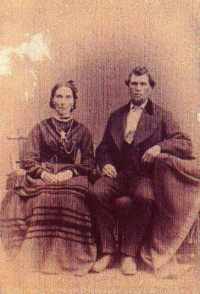
Thirza and Morley Haven
I asked for Joan Nay when I got in the store, and a busy clerk sent me to Acquisitions, 2nd floor. I made my way upstairs and hunted for the alcove-type office, tucked somewhere between the floor-to-ceiling bookshelves. I found her office and I found her. Like the other Nays I had interviewed, she was just a bit reluctant to tell me what she knew. (I now know a family trait is shyness and a tendency to avoid others.) As she bustled around the bookshelves, rarely making eye contact, she finally told me the story she had found, in bits and pieces, sandwiched between questions for me concerning my interest in the life of Thirza. Like Joy and I, Joan had a driving passion to know more about this woman, and had spent 20 years searching out her life. For the first time I heard details of a story about Thirza Angelina Hale Nay, who had left her family and the area with a soldier from the famed Johnson’s Army, then situated at Camp Floyd, close to Cedar Valley.
To be continued. . .
 assigned myself the task of transferring all of the genealogical records my mother had researched, accumulated and organized her whole life into my new computer system. The software I had was brand new, called “PAF” I think. The device I was using ran with a DOS program, ancient now, but at that time it was pretty much cutting edge for me. I was excited with the goal I had set for myself, and spent many a day working at the black and white screen, entering little numbers and ciphers that translated into my family history.
 more familiar with how to run the machine and with the names of
  those people with whom I shared my genes. (Hooray for second chances!) During this process, two names in particular kept coming into my mind, Thirza Angelina Hale and Thankful Lucy Pine. I determined when I completed my job, I would look more closely at their information and see what it was that was drawing me in. After several weeks, I finally came to that point, and discovered to my surprise these women were married to the same man.
 Mom's Tender Mercies